Moralstudy English

Abdul Shaheed Azhary is graduate from Al Azhar University, Ciaro. He has authored a couple of books on Islamic topics. He has been teaching Islamic and Arabic language subjects to students and adults for the last 15 years. He has studied the Arabic language, Quran, Hadees, Fiqh, Aqeeda, and other branches of knowledge from the Madrassas and Colleges in Kerala, India. He completed his higher studies at Al Azhar University in Egypt. He has also graduated with a BA from Calicut University and an MBA from Annamalai University.

The Moral Obligation of Scholars: Upholding Truth and Challenging Tyranny

The Prophet Muhammad (S.A.S) warned us about the consequences of associating with rulers. He said, من سَكن الباديةَ جَفا  ومَن اتَّبع الصَّيد غَفَلَ  ومَن أتَى السُّلطانَ افتُتِنَ  وما ازداد عبد من السلطان دنوا إلا ازداد من الله بعدا(أبوداود، والبيهقي،) “Whoever resides in the deserts, he becomes ignorant, whoever follows game, he becomes heedless, and whoever […]

The Moral Obligation of Scholars: Upholding Truth and Challenging Tyranny Read More »
Verses of Optimism: Finding Strength and Hope in the Quran

Discover how the teachings of the Qur’an inspire a positive outlook on life. This article explores the themes of gratitude, patience, and trust in Allah, which lead to inner peace and contentment. Explore how the Qur’an promotes kindness, mercy, and forgiveness, fostering harmonious relationships and a more optimistic worldview. Dive into specific verses that offer resilience and hope during difficult times, highlighting the presence of ease alongside hardship and the capacity to overcome struggles. Understand the importance of unwavering trust in Allah’s guidance, the concept of predestination, and the boundless mercy and forgiveness of Allah. Find strength and encouragement in these verses, cultivating a positive perspective and relying on Allah’s wisdom and care.

Verses of Optimism: Finding Strength and Hope in the Quran Read More »

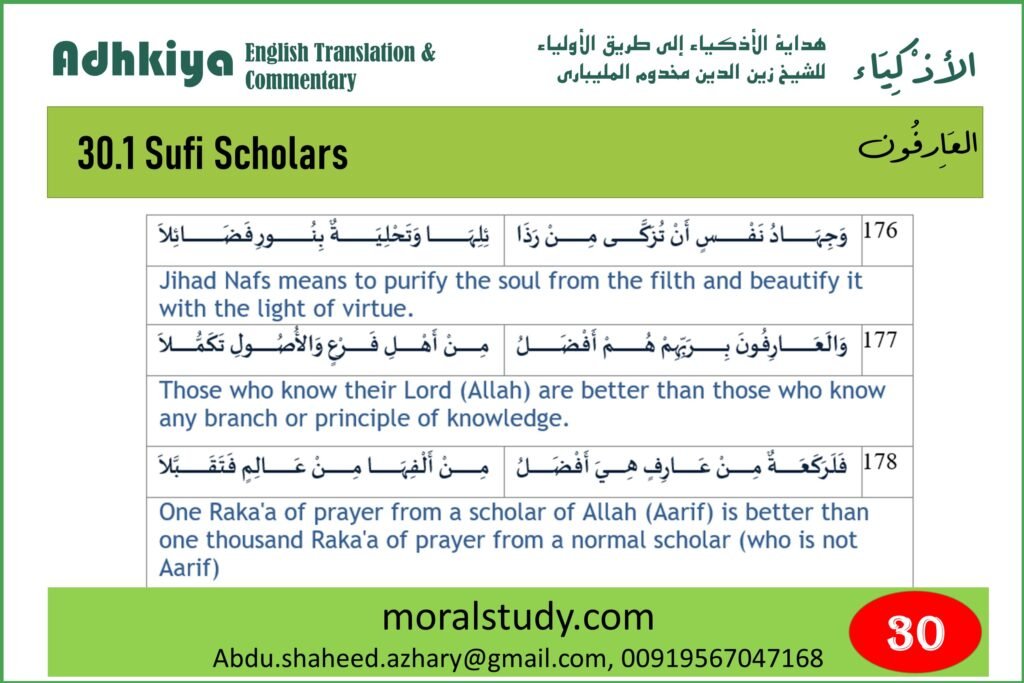
Sufi Scholars (العارفُون)

Jihad Nafs is to purify the soul from its vices, i.e. from evil qualities such as anger, arrogance, miserliness, envy, lust etc. and to adorn it with qualities such as humility, asceticism, and piety.
A scholar who strives to learn about Allah’s attributes and gives attention to the inner beauty of the soul is called ‘Arif’. The author says that Arif is much better than a normal scholar who only focuses on extracting the rules and giving Fatwa without giving much attention to beautifying the soul.

Sufi Scholars (العارفُون) Read More »

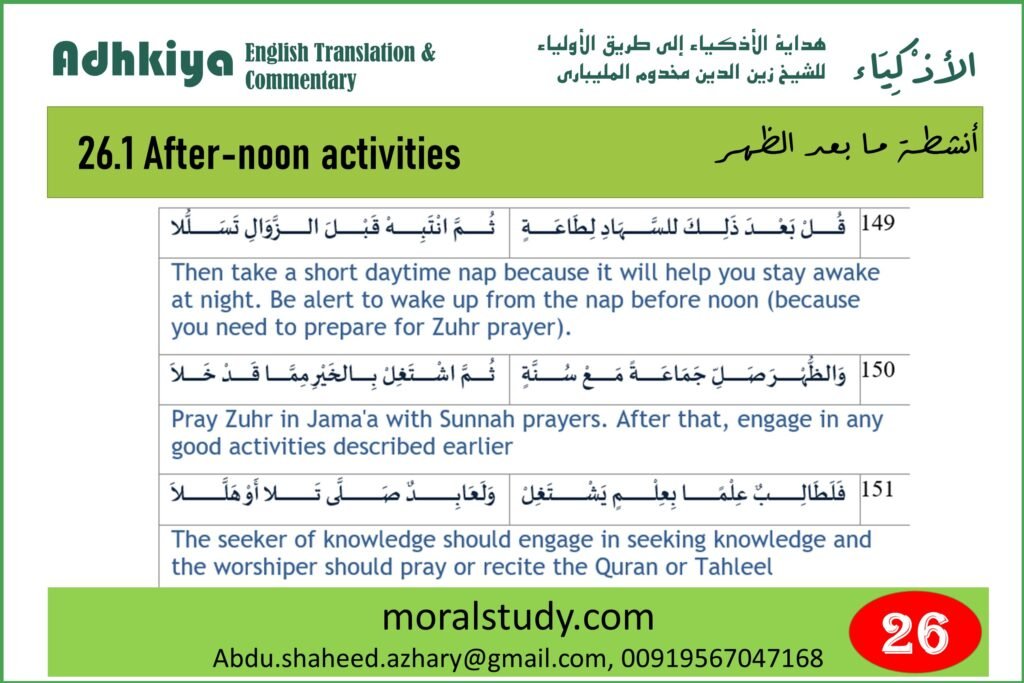
After-noon activities (أَنْشِطَةُ مَا بَعْدَ الظُّهْرِ)

Short daytime sleep (nap) has many health benefits. It relaxes and eliminates tension. It boosts memory capacity and increases concentration. A study has revealed that it helps the body run smoothly and gain energy and vitality. Here the author’s suggestion is to sleep after the study before praying Dhuhr prayer.

After-noon activities (أَنْشِطَةُ مَا بَعْدَ الظُّهْرِ) Read More »

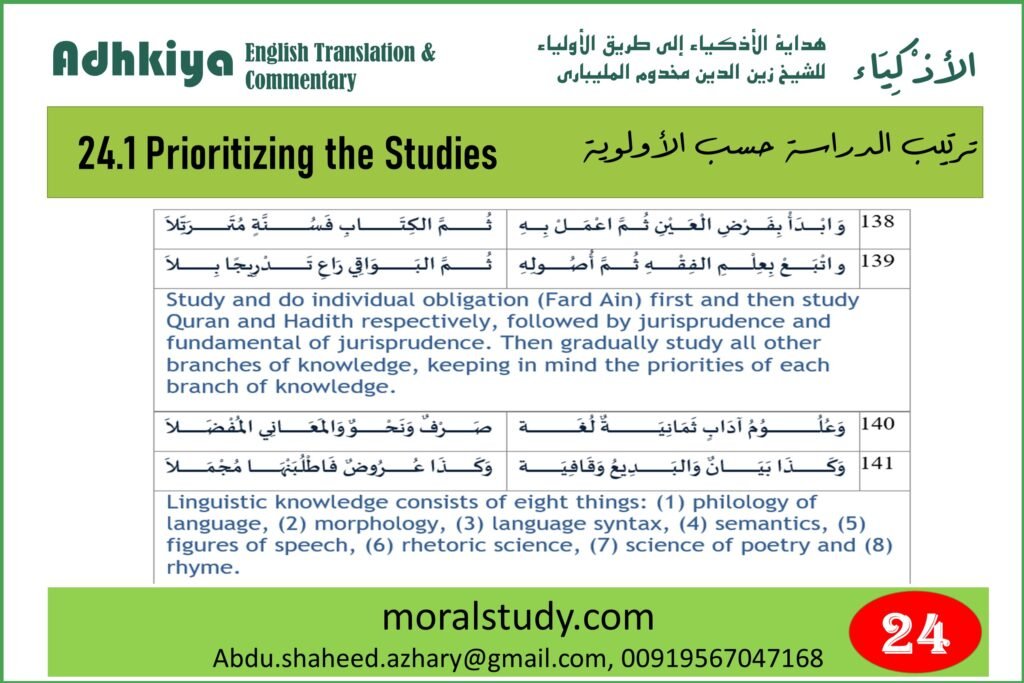
Branches of knowledge and Prioritization (علوم اللغة وتحديد الأولويات)

According to the Islamic jurisprudence view, there are two types of obligations: Fard Ain and Fard Kifaya. Those obligations that are individually responsible are called Fard Ain such as five times prayers and Ramadan fasting. Those obligations that are collectively responsible are called Fard Kifaya such as calling for five times prayers in a mosque. Seeking knowledge also either Fard Ain or Fard Kifaya

Branches of knowledge and Prioritization (علوم اللغة وتحديد الأولويات) Read More »

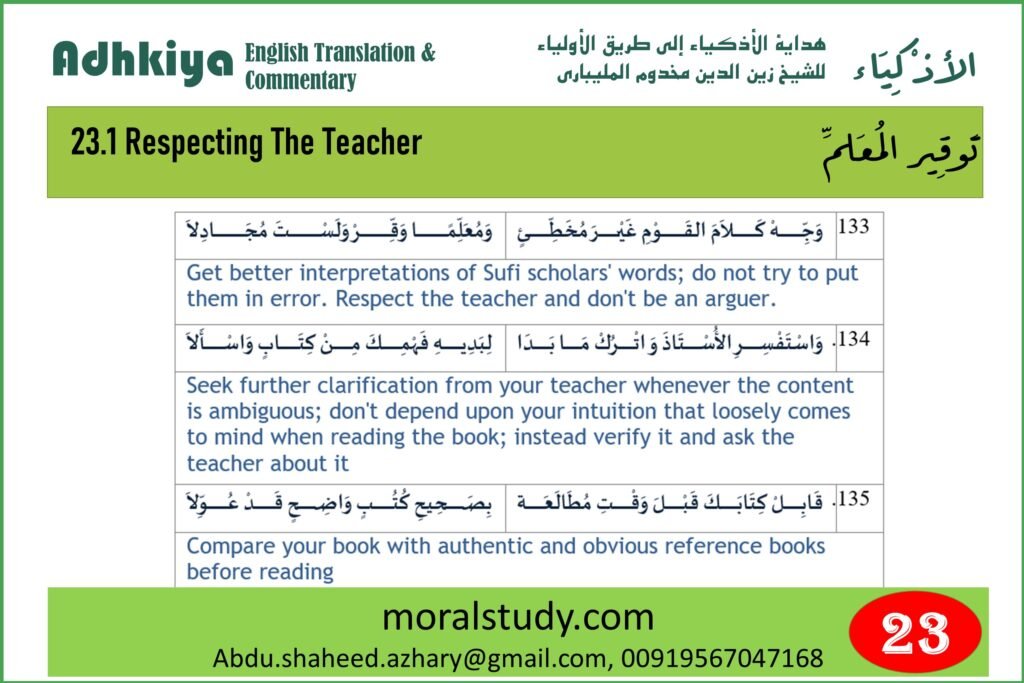
Respecting The Teacher (تَوقِير المعلم)

A teacher must master every branch of knowledge. Some branches depend upon talent while others depend upon a Master. Reading the Quran, Fiqh, Aqedah and Tasawwuf are some of the critical subjects that can only be learned through a master. As for a student of religion, his teacher plays an important role in shaping his personality and imparting knowledge. The student should seek the help of the teacher wherever he finds difficulty in understanding a text.

Respecting The Teacher (تَوقِير المعلم) Read More »